.
.
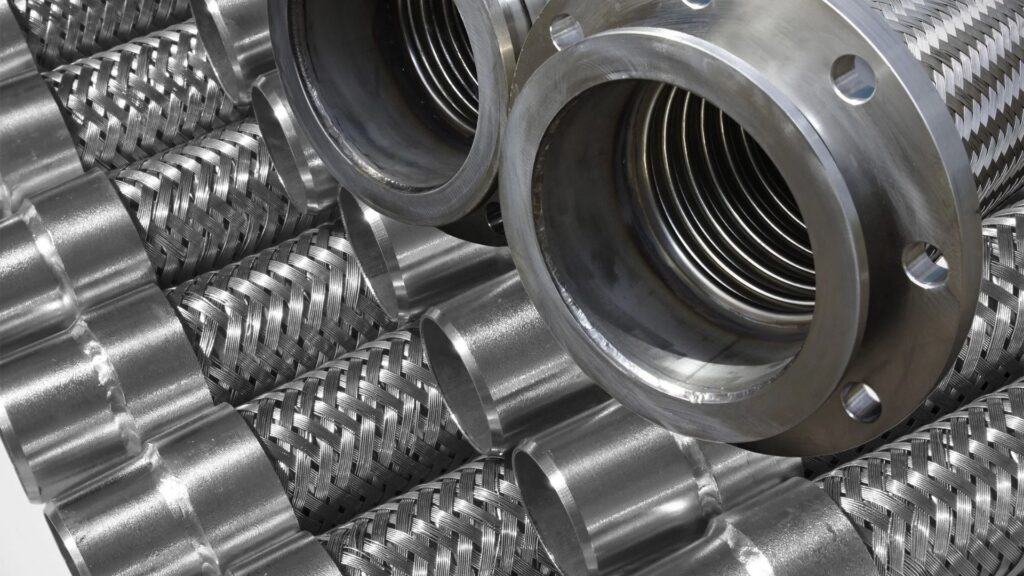
It’s all about vibration and how its resonance affects the connection and the service life of a pump. Vibration refers to the rapid oscillations of an object to either side of a centerline, and is a detrimental element in a piping system. Both metal hose assemblies and expansion joints are able to absorb that vibration and provide the flexibility needed.
However, between the two options, there are significant differences that lead to greater service life, dependability and safety.

.
- Constructed from a single layer of stainless strip.
- Resonance transfers into the machinery causing untimely breakdowns with substantial cost.
- Most readily available in 321 or 316 stainless steel.
- Moves only on two planes – Lateral (side to side) and Angular (one end moving, or bending, relative to the other).
- Designed to seal off vibration and take up only limited movement.
- Prone to vibration fatigue and premature failure. vibration can also cause the braid to cut through the top of the corrugations and damage the hose.
- The recommended lengths for this installation are longer than the space provided (as designated by ISO 10380 and NAHAD 400 standards).
- Multi-ply design with lower spring rates reduces stress on all of the individual components in the system.
- Minimizes resonance transfer and extends service life of the pump.
- Available in numerous stainless and nickel alloys as well as C276, which is more resistant to harsh chemicals such as chlorine.
- Able to move on three planes, Axial (compression and extension), Lateral (side to side), and Angular (one end moving or bending, relative to the other).
- Seals off vibration and takes full-range of movement.
- Provides an internal dampening of the vibration which extends the life cycle of the expansion joint.
- Appropriate engineered lengths facilitates easy
- installation and provides lowest total cost solutions for pump applications.
- Supplied with limit rods which prevent damage to the piping system by absorbing any thrust in pressure.
.